Colour coding school notebooks by subject: a simple cover system
A simple way for parents and teachers to colour code school notebooks with cover colours: a starter plan, extra subjects, labels and how much to buy.
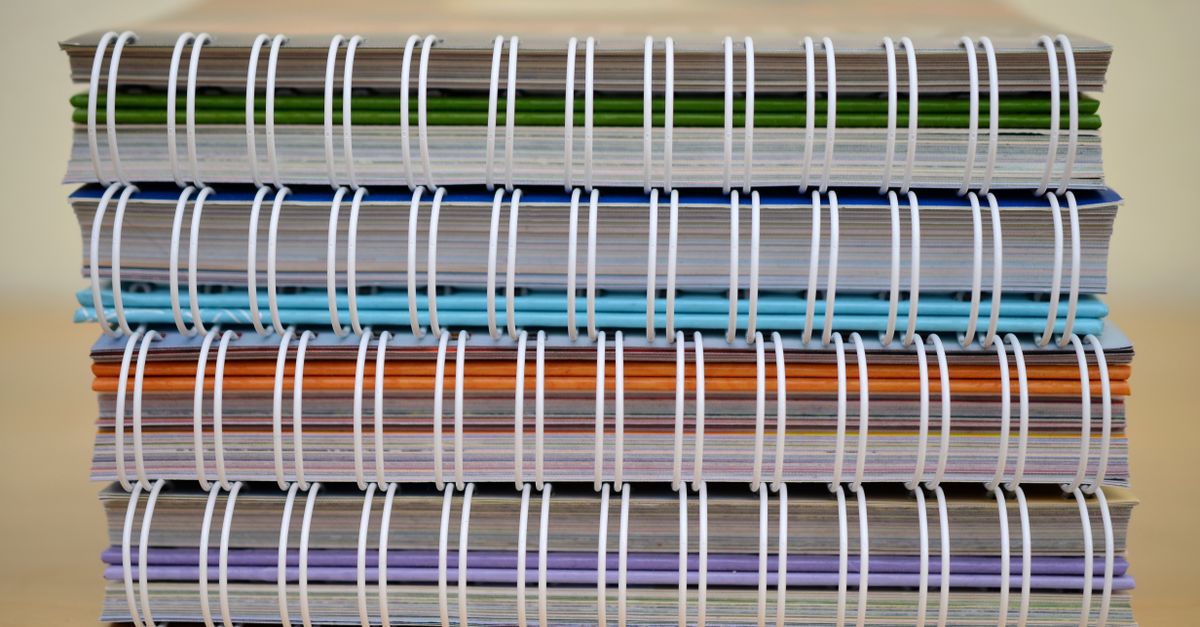
Give every subject one cover colour, and keep that colour for every notebook of that subject, at home and in class. Six standard cover colours (orange, pink, blue, brown, white and green) are enough for six subjects. For more subjects, keep the colour and change the design: plain, printed, lining, clear or fluorescent.
That is the whole system. The child finds the right notebook in the morning without emptying the bag, and a teacher can spot the wrong notebook in a stack of thirty at a glance.
I run Jagannath Polymers Pvt Ltd (JPPL), and we make notebook covers in these colours every season, so this article is partly practical maths from the plant. The idea itself is old and simple. It works only if everybody sticks to the plan.
Why colour code notebooks at all?
A school bag with many subjects has many notebooks that look the same from the side. A young child reads the spine slowly, if at all. A colour is seen in a second.
It will not make a child study more. What it does is take away one small daily fight, the hunt for the right copy at 7 in the morning. For a teacher, it makes collecting and checking notebooks quicker, because each subject arrives as one colour.
A starter colour plan
Here is one plan using the six standard synthetic colours. Treat it as an example, not a rule. Any plan works as long as it never changes during the year.
| Subject | Cover colour | A memory hook for children |
|---|---|---|
| Maths | Blue | Blue for the ruler and the graph lines |
| Science | Green | Green like a leaf |
| English | White | White like a clean page |
| Hindi | Orange | Orange like a marigold |
| Social science | Brown | Brown like the earth on a map |
| Computers or art | Pink | Pink for the fun subject |
If I were setting this up at home, I would let the children choose the hooks themselves. A colour they picked is a colour they remember.
More subjects than colours?
Six colours run out quickly once you add a second language, general knowledge, drawing or moral science. You do not need more colours. You need a second way to tell covers apart, and covers already give you several.
- Plain versus printed. A plain blue for maths and a printed cover on blue film (our Combo design prints on coloured film) for mental maths.
- Lining. A lining pattern in the same colour for the homework notebook of that subject.
- Clear. A clear cover shows the notebook's own design. I would use it for rough books and keep the colours for subjects.
- Fluorescent. Our Floura covers come in natural and up to 5 fluorescent colours, which stand out clearly from the plain synthetic colours.
You can see the designs on our notebook covers page.
What about children who mix up colours?
Some children cannot tell certain colours apart. This is colour blindness, and a child may not even know they have it. A colour-only system can quietly leave that child behind.
So always add a label with the subject name, in big letters. Choose one spot, say the top right of the front cover, and use it on every notebook. The colour then helps most children, and the label helps everyone.
How much cover do I need?
Here the maths surprises most parents. The full working is in how many notebooks one cover roll covers.
A regular notebook of about 24 x 18 cm needs a piece of about 30 x 43 cm, with 3 cm folds. On a 14 inch roll, each cover uses about 43 cm. So an 8 m roll covers about 18 notebooks, a 5 m roll about 11, and a 3 m roll about 6.
Now take one child with six subjects and two notebooks per subject. That is 12 notebooks, but only 2 per colour. Two covers use well under a metre. Buying a full 8 m roll in each of six colours leaves most of every roll unused.
Better options for one family:
- Buy a multicolour pack instead of single colours. We pack our Combo carton with 5 colours x 40 rolls for the trade, and PackSmith, our sister brand, sells a set of 4 multicolour rolls (14 inch x 7.5 m) online.
- Split rolls with two or three other families who follow the same plan.
- Keep the leftovers. They cover next year's notebooks and mid-year replacements.
For a teacher setting a class plan, the numbers flip. Thirty children with two maths notebooks each need 60 blue covers. At about 43 cm each, that is close to 26 m, so four 8 m rolls of blue.
For teachers: setting a code for the whole class
A class-wide code works best when it is announced once and early.
- Put the colour plan on the book list that goes home before the session starts.
- Use standard colours only. If you ask for an unusual shade, parents will not find it in every shop.
- Keep the same plan for every section of the class, so a child who changes section does not have to recover a single notebook.
- Keep a spare roll of each colour in the classroom for the child who arrives with a torn cover.
I have to be honest about one weak point. A shop can run out of a popular colour in the busy weeks before schools reopen. Covers sell most from February to June, and if your plan depends on one colour, ask your shop to keep it aside early.
For distributors: stock for colour coders
If schools in your area use colour plans, make sure the shops you supply keep all six standard colours in depth. Orange and brown alone will not do. Our standard synthetic colours are orange, pink, blue, brown, white and green, and other colours can be made to order for a large order. A shop that can sell a full set in one visit saves the parent a second trip, and parents remember that.
I think this page is worth sharing with your retailers.
A shopkeeper who can explain the system to a parent has an easy reason to suggest all six colours. We would rather your retailers sell a full set than one roll.
Tell us which colours the schools in your area ask for, and we will help you plan the cartons before the season.
Questions buyers ask
What colour should maths notebooks be?
There is no official colour. Pick any colour you can buy again easily, write the plan down, and keep maths in that colour for every maths notebook, this year and next. Consistency matters far more than the colour itself.
How do I colour code classwork and homework notebooks?
Keep the subject colour the same and change the design. For example, a plain cover for classwork and a lining design in the same colour for homework, or a clear cover with a coloured label for rough work.
Is colour coding useful for older students?
Yes, for anyone who carries many notebooks. Older students often add a second level, such as a sticker for each term or unit, while keeping one colour per subject.