How long does a plastic book cover last? What wears it out, and how to make it last
A plastic book cover should last as long as the notebook is in use. What actually wears covers out, thick versus thin film, and simple care tips.

A plastic book cover should last as long as the notebook it protects, and for most school notebooks that means one session. If a cover splits or slips off in the first few months, the film is rarely the only reason. It is usually the way it was put on, or a cover that was too thin for a child who is hard on books.
At Jagannath Polymers Pvt Ltd (JPPL) we make notebook covers in BOPP, PP and synthetic (HM) film. So I look at a failed cover a little differently from most parents.
A cover does not wear out evenly. It fails at four or five particular points, and if you protect those points, the rest of the film looks after itself.
What wears a plastic book cover out?
Here are the usual culprits, roughly in the order they show up.
- The corners. A notebook in a school bag rubs against other books, the zip and the lunch box all day. The four corners take most of that rubbing.
- The spine. Every time the notebook opens, the cover bends at the spine. A cover pulled very tight across the spine gets stressed there and can split along the fold.
- Short folds. If the flaps tucked inside are only a centimetre or two, they slip out, the cover goes loose, and a loose cover catches on everything.
- Tape that lets go. Cheap tape loses its grip, and then the flaps open up.
- Sharp things in the bag. Compass points, open pens and the corners of a geometry box can cut any film.
- Sun and heat. Sunlight fades colours and prints on almost anything over time. Do not leave notebooks on a car dashboard or in direct sun, and never press a covered book with a hot iron.
None of these is a film problem first.
That is good news, because every one of them can be fixed at home, without buying anything expensive.
Does a thicker cover last longer?
In a rough school bag, yes, usually. Thicker film is stiffer, holds its shape at the corners and resists tearing better.
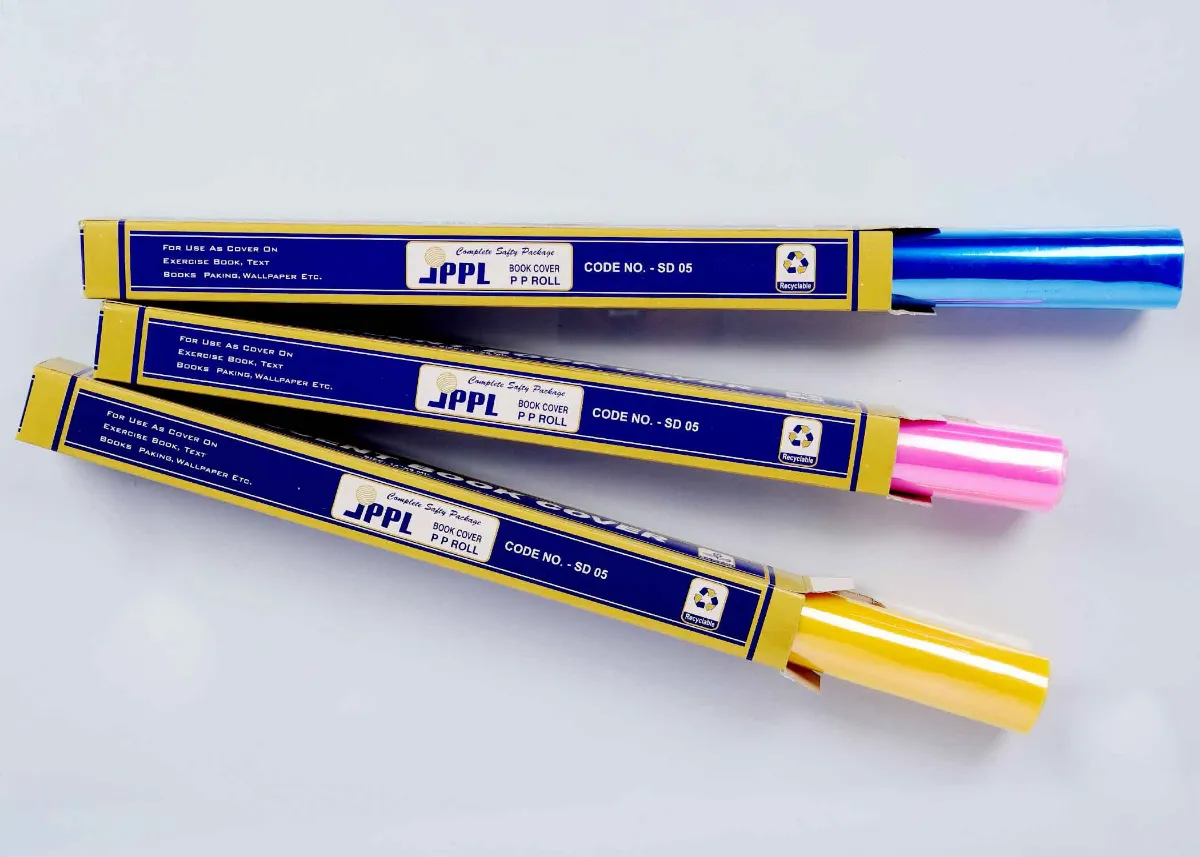
We make our covers from 50 to 75 micron, and the difference is real. Star is 50 micron, Vidhyarthi 55, Student 60, Student JPPL 70, and Unique 75 with an embossed lining. A 70 micron cover is 40 percent thicker than a 50 micron one, which you can feel the moment you fold it. For a child who carries every notebook to school every day, I would pick Student JPPL, our 70 micron best seller.
| If the notebook... | Choose |
|---|---|
| Goes to school every day in a heavy bag | 60 to 75 micron, such as Student, Student JPPL or Unique |
| Stays mostly at home or in a desk | 50 to 55 micron is enough, such as Star or Vidhyarthi |
| Is thin, and a small child covers it alone | A thinner, softer film folds more easily |
| Needs to show the notebook's own design | Clear BOPP, from our transparent covers |
I will admit one thing that does not suit a manufacturer's sales pitch. Thicker is not always better. A stiff 75 micron cover on a thin 40 page notebook is harder for a small child to fold neatly, and a badly folded thick cover lasts less than a neatly folded thin one. Match the film to the book and to the person putting it on.
Whatever you buy, check that it is at least 50 micron. Our micron guide shows how to check it at home. Every JPPL cover is 50 micron or thicker.
That is the floor I would hold any supplier to, including us.
How do I put a cover on so it lasts?
Most of the life of a cover is decided in the first five minutes, at the dining table. Our how to cover a notebook guide shows the steps with pictures. The points that matter for long life are these:
- Cut enough film. For a regular notebook of about 24 x 18 cm, cut a piece of about 30 x 43 cm. That leaves about 3 cm to fold in on every side.
- Pull it snug, not tight. The film should sit flat on the front and back without bubbles, with a little ease at the spine so the notebook opens without strain.
- Fold the corners like a parcel. Tuck the corner in at an angle before folding the flap, so no loose triangle sticks out.
- Tape the flaps to each other at the corners, not to the notebook. A short piece of clear tape is enough. Our narrow stationery tape in 12, 18 and 24 mm widths is made for this kind of job.
- Press every fold flat with your thumbnail.
How do I take care of a covered notebook?
A little care through the year goes a long way. I would put these five habits on the fridge door.
- Wipe spills and dirt with a damp cloth. Plastic does not soak up water the way paper does, so a quick wipe is usually all it needs.
- Do not attack ink marks with nail polish remover or other strong solvents. They can smudge or lift the print on a printed cover. If you must try a cleaner, test it on a corner first.
- Keep the geometry box in its own pocket of the bag, away from the notebooks.
- Do not stuff the bag. Bent notebooks mean bent covers, and a crease turns into a split.
- Fix a lifting flap the same day with a fresh piece of tape. A loose flap left for a week can easily become a torn corner.
When should I replace a cover?
Look for three signs: a split at a corner or along the spine, a flap that will not stay in, or white lines where the film has been creased hard again and again. White lines mean the film is stressed at that fold, and that is where it is likely to split next.
Do not keep taping over a split.
Cut a fresh piece and start again. An 8 m roll covers about 18 regular notebooks and a 3 m roll about 6, so one spare roll at home goes a long way for repairs.
Can a plastic cover be used again?
Sometimes. If the flaps were taped only to each other, the cover can slide off in one piece at the end of the session. It can then go on another notebook of the same size. A cover with split corners or white crease lines belongs in the dry waste, not on another book.
If you are a distributor or wholesale dealer, this is a useful page to share with the retailers you supply, because these are the questions parents bring to their counter. To see which of our designs suit which customers, the synthetic book covers page lists every thickness. We are happy to help you choose.
Tell us how the families in your area actually use their notebooks, and I will suggest the right micron.
Questions buyers ask
Does a thicker book cover last longer?
Usually yes in a rough school bag, because thicker film resists corner wear and tearing better. But thickness only helps if the cover is put on well. A 75 micron cover with short folds will still come loose before a neatly folded 50 micron one.
Can I reuse a plastic book cover next year?
Sometimes. If you taped only the flaps to each other and not to the notebook, the cover can come off in one piece and go on another notebook of the same size. If it has white crease lines or split corners, cut a fresh piece instead.
Why does my child's book cover keep slipping off?
The folds are too short or the cover is loose on the book. Leave about 3 cm to fold in on every side, pull the cover snug before folding, and put a small piece of clear tape where the flaps meet at the corners.