Custom printed notebook covers: how own-design printing works
How a distributor gets notebook covers printed in its own design: what to send, why roll artwork is different, and the artwork mistakes to avoid.
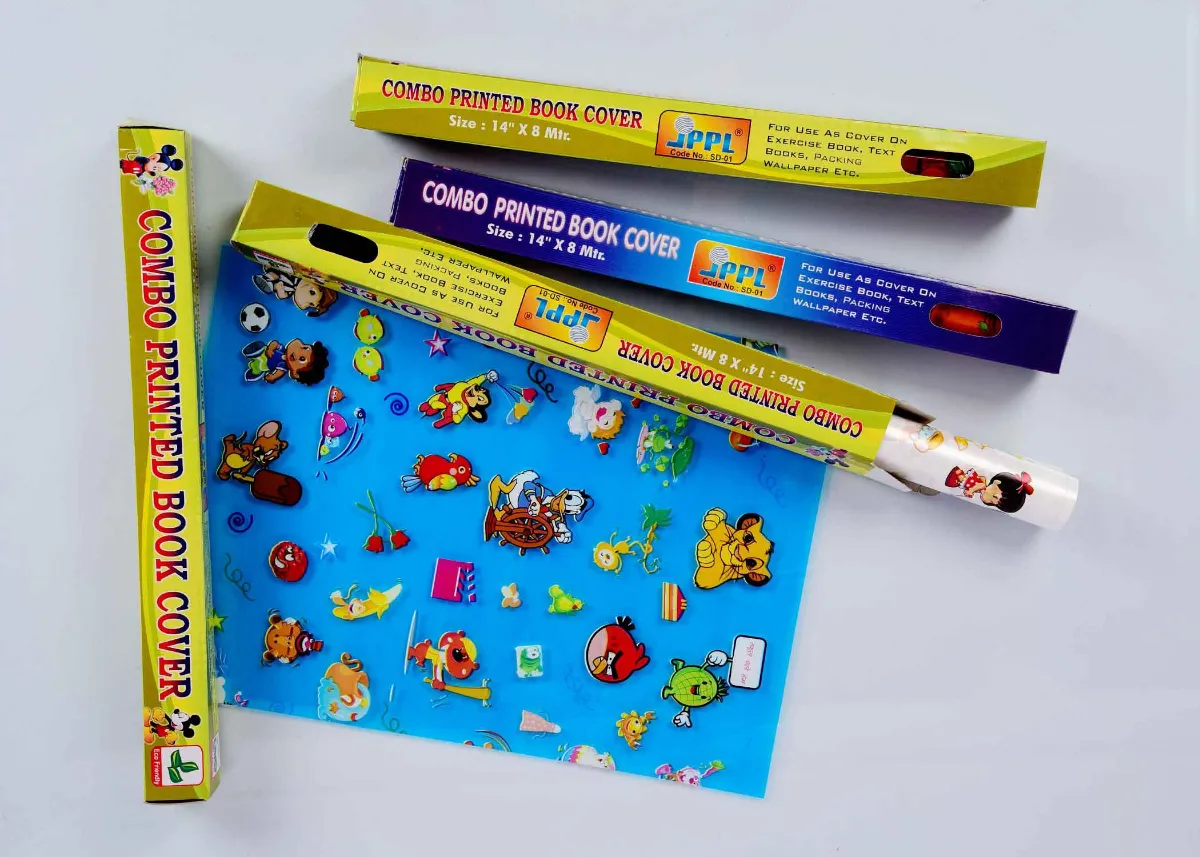
A custom printed notebook cover starts with your artwork. You send the design, or even a photo of a cover you sell today, and we at Jagannath Polymers Pvt Ltd (JPPL) tell you whether it can be printed on our film, at what width and length, and the minimum quantity for a new design. Once you approve the final artwork, it is printed on the roll and packed in the series you choose.
There is one thing most people ordering their first custom design do not expect. A roll is not a book cover.
Every child cuts it at a different point, so the design has to look right wherever the scissors land. Most of this article is about that, because I think it is the part that decides whether a custom design sells.
Who orders custom printed covers?
Mostly distributors and wholesale dealers. Some want a design nobody else in their market has. Some sell under their own brand name. Some supply school suppliers, who ask for a school's name on the cover.
It is not a route for a parent who wants ten covers with a child's name on them, or for a single shop. I say this plainly, because a new design needs setup work before the first metre is printed, and that cost has to be spread over a reasonable run. For small needs, our existing designs or a plain colour make more sense.
What printed designs do we make today?
These are our running printed designs, all at 50 micron or thicker:
- Classic: multicolour print on clear BOPP. The notebook's own cover shows through between the motifs.
- Combo: multicolour print on coloured BOPP. The colour hides the notebook underneath.
- Lining: lining patterns printed on BOPP.
- Standard multicolour print: printed PP in 11 and 13 inch, sold mostly by the kilo.
You can see them on our printed notebook covers page. If one of them is close to what you want, start there. A small change to a running design can be an easier conversation than a design from zero.
Why does roll artwork need a different design?
Let me show you the maths.
It decides the artwork more than any designer's taste.
A regular notebook of about 24 x 18 cm needs a piece of about 30 x 43 cm, with 3 cm folded in on each side. On a 14 inch (355 mm) roll, the 30 cm runs across the width of the roll, and each cover takes about 43 cm along its length. So:
- Across the width, about 5 cm of the 35.5 cm is trimmed away, and another 3 cm on each side folds inside the notebook. Anything printed near the edges of the roll may never be seen.
- Along the length, nobody knows where the cut will fall. The front of one notebook may show the left half of your motif and the next notebook the right half.
- The spine sits in the middle of each 43 cm piece. A big character placed there gets folded in half.
So a good roll design is an all-over pattern. Keep the motifs small enough that several complete ones fit on the front of every notebook, whatever the cut. Repeat your brand name small and often, rather than printing it once large.
We will point out these problems when we see your artwork, but it saves a round of changes if you plan for them from the start.
Artwork designed like a poster, with one big picture in the centre, looks broken on almost every notebook once it is on a roll. It is far cheaper to find this out on screen than on a carton.
Clear film or coloured film?
This choice changes the look more than most people expect, and BOPP vs PP vs HM explains how the films differ. I would decide it before the artwork, not after.
On clear film (the Classic style), the notebook's own cover is the background. A busy notebook cover under a busy print can look messy. Plain notebooks look best.
On coloured film (the Combo style), the film colour is the background for every notebook, which gives a uniform look in a shop display. Inks look different on a coloured base than on white paper or a screen, so ask to see a printed sample of a similar design on the same film before you approve the colours.
Artwork tips that save a reprint
- Send a vector file if you have one (PDF, AI or CDR), with fonts converted to outlines. A phone photo is fine to start the conversation, but not to print from.
- Give colours as references or send a printed sample to match. A colour on your laptop screen is not a colour on film.
- Ask how many colours the quote includes. More colours can change the cost, so decide early which ones really matter.
- Avoid hairline strokes and very small text. Fine detail that looks sharp on screen may not hold on film.
- Print only what you own. Popular cartoon characters belong to their owners. Do not ask any printer, including us, to print a character you have no licence for.
- Approve the final artwork in writing. Do not let any printer start a run on a verbal "looks fine".
What do I send for a quote?
- Your firm's name, your city and your GST number.
- The design or artwork, or a photo of a cover you sell today.
- The width, the length and the series: boxed one roll per box, five rolls per polybag, or Standard by the kilo. Our sizes and packing page lists what each series comes in.
- The quantity per order, and how many orders you expect in a year.
- When you need the goods in your godown.
We reply with what we can make and a quote.
A price without the design is only a guess, so send the design first. The minimum quantity for a new design is confirmed on that quote, design by design.
Do I need printing at all?
Not always. Honestly, I would ask this question first. A distributor can also set its range apart with a plain colour and its own packing. Our standard synthetic colours are orange, pink, blue, brown, white and green, and other colours can be made to order. A plain colour that no other distributor in your market sells can do the job of a print, with less setup.
Timing matters either way. Covers sell most from February to June, before schools reopen, and most of our range is made to order. A custom design ordered in March is a design that misses half the season.
Send us your artwork through the enquiry page, even a phone photo is fine. I will tell you honestly whether it suits a roll, and what to change if it does not. You can also read more on our custom printing page.
Questions buyers ask
Can a school's name or logo be printed on notebook covers?
Yes, through a distributor who places the order with us. A new design has a minimum quantity, which we confirm on the quote. Plan the artwork as a small repeating pattern, because each child will cut the roll at a different point.
Can I order a small quantity in my own design?
Usually not economically. A new design has a minimum run. If you need only a few cartons, pick one of our existing Classic, Combo or Lining designs, or a plain colour, and put your own label on the packing.
Which film is used for printed covers?
Our Classic, Combo and Lining designs are printed on BOPP film, clear for Classic and coloured for Combo. Standard rolls with multicolour print are PP, in 11 and 13 inch.
How early should I place a custom order?
Well before February. Covers sell most from February to June, most of our range is made to order, and a new design also needs time for artwork approval before printing starts.