Choosing a notebook cover manufacturer in India: a checklist for distributors
For stationery distributors and wholesale dealers: check the plant, micron, roll size, packing and season stock before you order notebook covers in bulk.
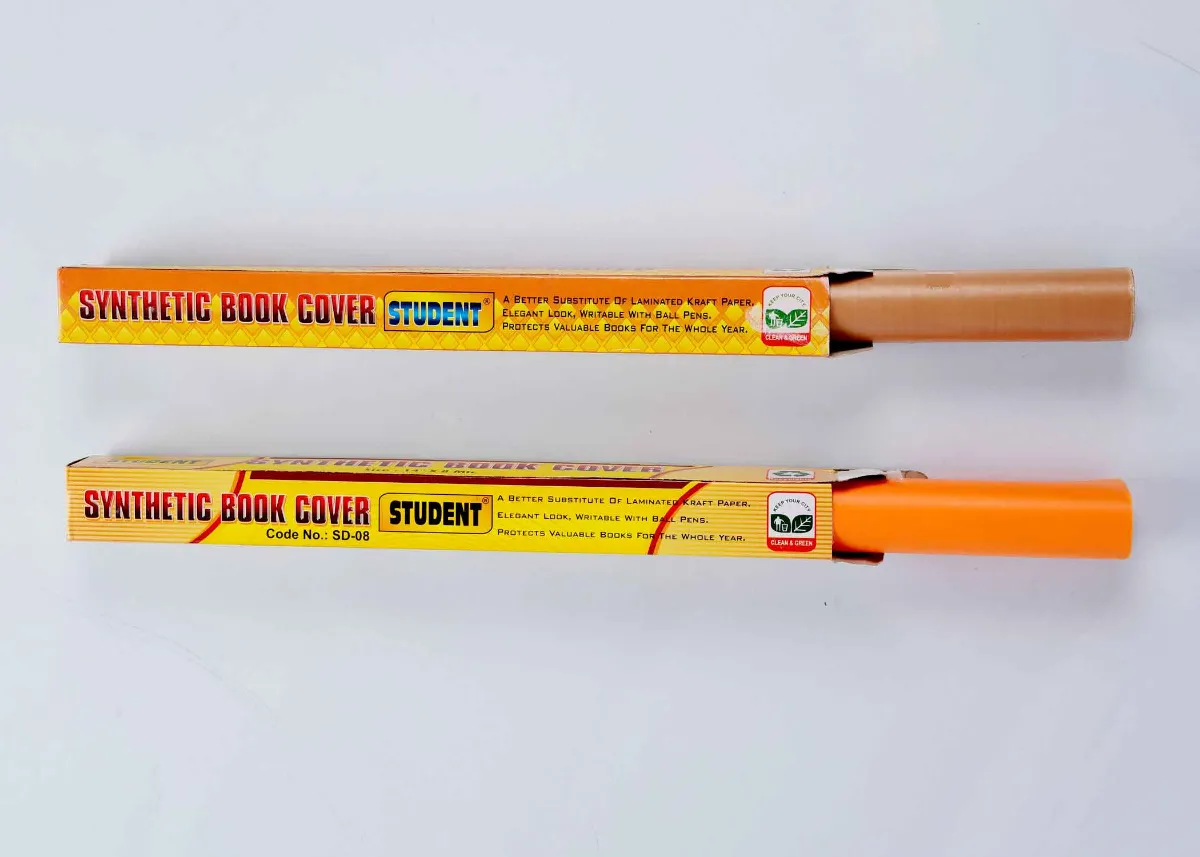
Most distributors choose a notebook cover supplier on the rate per roll. I think that is the wrong place to start. First check four things: who actually makes the cover, how thick it is, whether the roll is the size printed on the box, and whether the supplier can deliver in February when every shop wants stock at once.
Get those four right and the rate becomes an easy conversation. Get them wrong and a cheap roll costs you a season, and costs your retailers one too.
I run Jagannath Polymers Pvt Ltd (JPPL), and notebook covers are one of our main products. We sell them to stationery distributors and wholesale dealers, the trade that supplies shops and school suppliers, so this guide is written for you. So yes, I have an interest here. But the checklist below works for any manufacturer you talk to, including us.
What should I check before choosing a notebook cover manufacturer?
Here is the list I would use if I were a distributor buying for a season, in the order I would ask.
- Is it their own plant? Many sellers are traders. That is not wrong, but a trader cannot change the micron, the width or the print for you. Ask where the film is made and where it is slit and rolled. A factory visit settles it.
- What is the micron, in writing? Ask for the thickness on the quotation and the invoice, not on a phone call. Below 50 micron, a plastic sheet does not meet India's rules (more on that below).
- What is the real width? Notebook cover widths are sold in inches. Ask for millimetres too. Our 14 inch roll, for example, is 355 mm.
- What is the real length? A box that says 8 m should hold 8 m. Unroll one sample on the floor and measure it with a tape. It takes two minutes.
- Which film is it? A good maker will name it: BOPP, PP or HM-HDPE. These films look, feel and wear differently. Our guide on what a synthetic book cover is explains the HM one.
- How is it packed? Ask for rolls per box, boxes per packet, packets per carton, and whether a carton holds one colour or a mix. Your godown staff will thank you when they unpack.
- What is in stock and what is made to order? Most cover ranges are made to order. Ask which items are kept in stock all year.
- Can they handle the season? Covers sell most from February to June. Ask how early they want your order to deliver before the rush.
- Can they print your design? If you sell under your own brand, ask for custom printing options at the start, not after you have placed the order.
How do I check a sample myself?
Do not trust a catalogue photo. Ask for two or three sample rolls and spend fifteen minutes with them.
- Thickness. Measure one layer of film with a micrometer at three or four places and take the average. A school screw gauge reads to 0.01 mm, which is 10 micron, so it will catch a big gap but not a small one. A digital micrometer that reads to 0.001 mm is better. On a two-layer tube roll, cut it open first so you measure a single layer.
- Length. Unroll one full roll and measure it end to end.
- Width. Measure across the roll in millimetres and compare with the box.
- Print. On a printed cover, rub the print firmly with your thumb a few times. It should stay on the film and not on your thumb.
- Fit. Cover one of your best-selling notebook sizes. If the cover is short at the folds, the width is wrong for your market.
If two samples from the same supplier differ in length or micron, ask why before you place a big order.
Is a 50 micron cover required by law?
Yes, as far as plastic sheets go. When the government notified the Plastic Waste Management Rules, 2016, the Press Information Bureau release of 18 March 2016 said the rules "stipulate minimum thickness of 50 micron for plastic sheets", to help collection and recycling.
Every cover we make is 50 micron or thicker. Our plain synthetic covers go up to 70 micron, and the embossed Unique cover is 75.
What about the 2022 plastic ban? Book covers were not on the list of single-use plastic items banned from 1 July 2022. The Press Information Bureau release of 13 August 2021 gives that list: items like plastic sticks, cutlery, straws, thin PVC banners and the wrapping film around sweet boxes and cigarette packets. Some states have their own extra rules, so a distributor should check with the State Pollution Control Board too.
Trader or manufacturer: does it matter for a smaller dealer?
Honestly, not always. A smaller dealer who sells a few hundred rolls a season is often well served by a bigger wholesaler nearby, who keeps stock close and can top you up in the middle of the rush.
It starts to matter when you buy by the carton, sell under your own name, or need a fixed micron every year. Then you want to talk to the people who run the machines.
Who is JPPL?
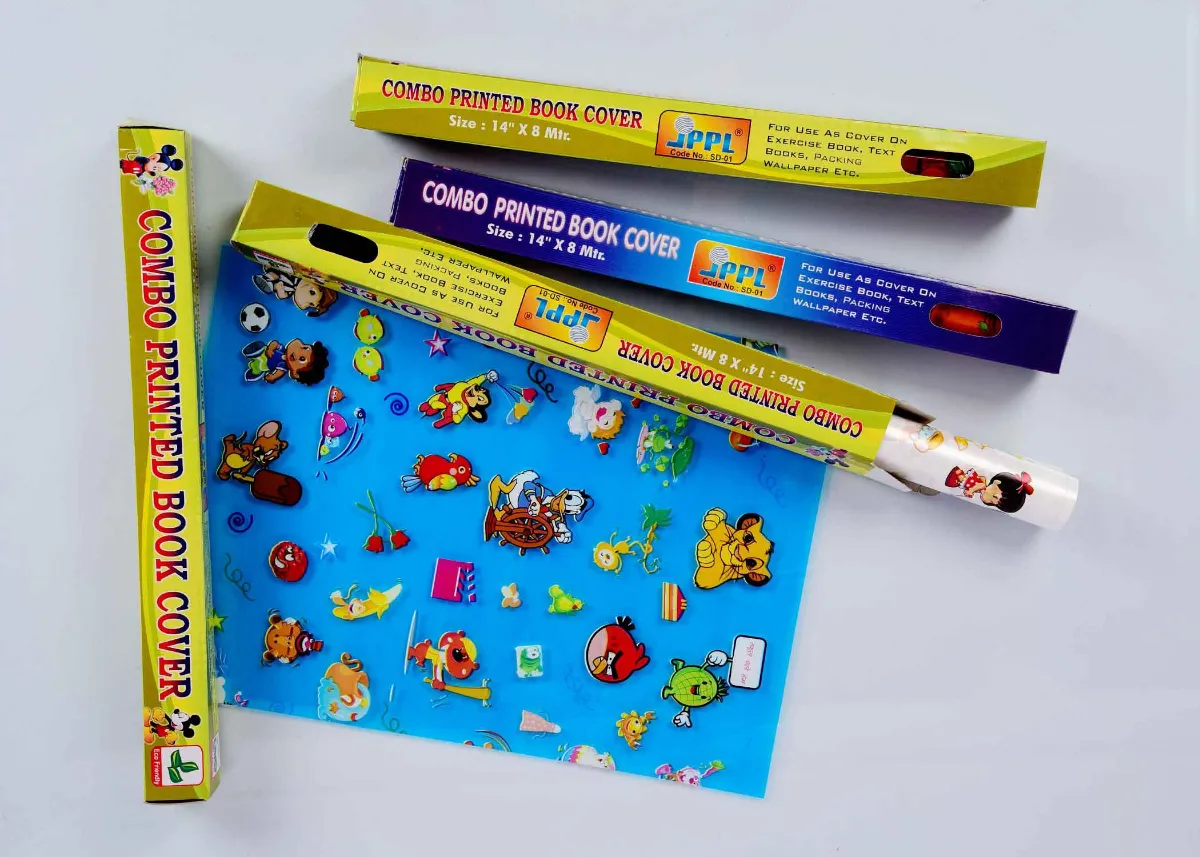
JPPL is a family-run packaging manufacturer in Jaipur, Rajasthan. The company was founded in 1995, has been manufacturing since 1997, and exports to 20+ countries. Our notebook covers are made in our own plant and sold mainly to stationery distributors and wholesale dealers, who supply the shops and school suppliers in their area.
We make covers in four series.
| Series | What it is | Size | Packing |
|---|---|---|---|
| Super Delux | Boxed roll, one per box | 14 inch x 8 m | 200 rolls per carton (180 for Floura, Student JPPL and Unique) |
| Delux | Same designs, no box | 14 inch, 2.5 to 5 m | 5 rolls per polybag, 250 per carton |
| Standard | Two-layer PP tube, sold mostly by the kilo | 11, 13, 14, 16 inch, 1.75 to 8 m | 18 kg or 16 kg bags, packets of 10 |
| Supreme | Wide PP sheet | 16 or 19 inch, 3 m or 5 m | 10 per pouch, 350 per carton |
Our best sellers are Student JPPL, Unique, Floura and Clear. You can see every design on our notebook covers page, and the carton details on sizes and packing.
Where we are not the right fit
I will be plain about our limits, because they save both of us time.
We make no paper covers. I explain why in why we do not make paper book covers. We do not publish prices, because film prices move and an old rate on a website helps nobody. And most of our range is made to order, so a distributor who calls in April for a big order will usually wait behind the people who ordered in January. Only two items are in stock all year: the 11 inch x 2 m and 13 inch x 3 m natural Standard rolls.
That last point is the one I wish more distributors knew. In this trade, the order you place in December decides how well you sell in May.
If you are planning next season, send us your sizes, designs and rough quantities through our contact page. We will tell you what we can make and when.
Questions buyers ask
Does JPPL make paper notebook covers?
No. We make only plastic covers, in BOPP, PP and HM-HDPE film, all 50 micron or thicker. If your retailers insist on paper, we are not the right supplier, and I would rather say so on day one.
Can a distributor get covers in its own design?
Yes. Own-design printing is something we do for distributors who sell under their own name. Send us your artwork and the sizes you sell through our custom printed notebook covers page.
I only need a few packs. Can I still buy JPPL covers?
Yes. Our sister brand PackSmith sells small packs online, so you do not need to take a full carton.
Is a 50 micron book cover legal in India?
Yes. The Plastic Waste Management Rules, 2016 set 50 micron as the minimum for plastic sheets, and book covers were not on the list of single-use items banned from 1 July 2022. State rules can add to this, so check with your State Pollution Control Board if you are unsure.