Paper cover vs plastic book cover: which is better for school?
Paper or plastic book cover for school? A side-by-side table on life, tearing, spills, look, cost over a year, reuse and disposal, and a clear verdict.
For a book that goes to school every day for a full year, a plastic cover of 50 micron or more is the better choice. It survives the school bag, a spilled water bottle and the monsoon, and one cover usually lasts the year.
Paper still has real advantages, and I list them below. But on daily school use, it loses more often than it wins.
I should say up front that I am not neutral. My company, Jagannath Polymers Pvt Ltd (JPPL), makes plastic covers, and we make no paper covers at all. I have written separately about why we do not make paper covers. Here I have tried to give paper a fair hearing. If you are a distributor, this is the question your retailers hear from parents every season, and you are welcome to share this page with them.
Paper vs plastic book cover: the comparison table
| Point | Brown paper cover | Plastic cover (50 micron or more) |
|---|---|---|
| Life on a school book | Often needs re-covering during the year, mainly at corners and spine | Usually lasts the full year if the folds are done well |
| Tearing | Tears once a corner gets wet or worn | Resists tearing at normal use, thicker film holds better |
| Water and dirt | Soaks up spills and leaves marks | A spill or a dirty hand wipes off with a cloth |
| Look | Plain brown, the classic school look | Clear, printed, fluorescent or plain colour |
| Seeing the book | Hides the book's own cover | Clear film shows the book's printed cover |
| Writing on it | Easy with any pen | Needs a name label or sticker |
| Cost per book over a year | Each re-cover means buying and fitting another sheet | Usually one cover for the year |
| Reuse | Rarely survives to a second year | Can sometimes be removed and reused |
| Disposal | Breaks down if littered, goes with paper waste | Lasts long if littered, goes with dry waste for collection |
Which lasts longer, a paper cover or a plastic cover?
Plastic, for a simple reason. Paper's weak points are the corners and the spine. These are the places that rub against the bag and the desk every day, and once they get damp, paper softens and splits.
A plastic cover wears at the same places, but much more slowly, and damp does not soften it. Thickness matters here. Thicker film holds its shape better at the corners, so for a book that has to last, I lean towards 60 micron or more.
What about water, dirt and the monsoon?
This is where paper loses most clearly.
A wet umbrella, a leaking water bottle or a muddy hand will mark a paper cover for good. On plastic, you wipe it off.
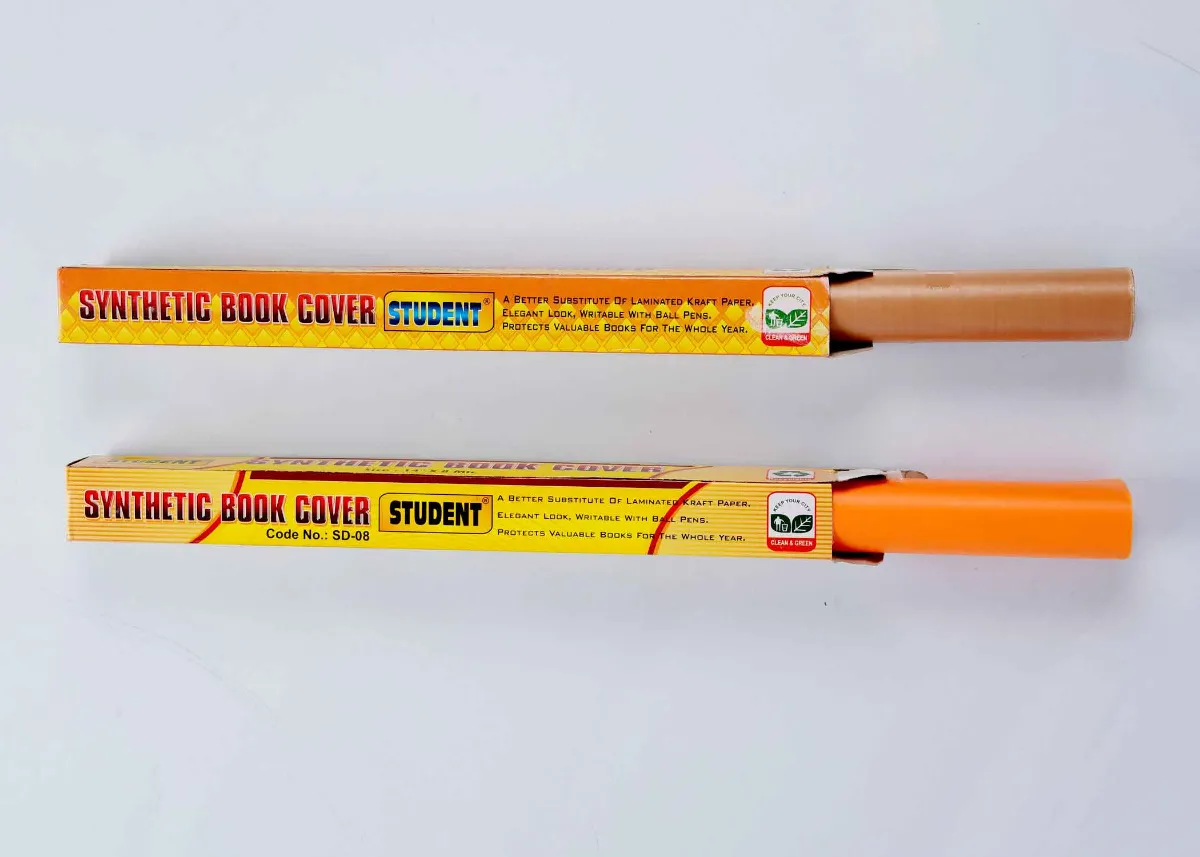
You can see the verdict in any school bag. Families who choose a brown paper cover very often put a transparent plastic cover over it, just to get it through the year. If the book ends up in plastic anyway, a single synthetic cover in brown or orange does the same job in one layer. That is why we make our covers synthetic.
No plastic cover keeps water out completely, and we never claim that for ours. I would be wary of anyone who does. Water can still get in at the folds and the open edges. But the face of the cover does not soak anything up, and that protects the book's own cover underneath.
Is a plastic cover cheaper than paper over a year?
In my view, yes, and the reason is replacements. Shop prices for both vary by town and thickness, so I will not quote numbers. What decides the cost is one count: how many times you re-cover the same book in a year.
Count it this year. Each time a paper cover tears, you buy another sheet and spend another evening fitting it. A plastic cover fitted at the start of the session is usually still on the book at the end of it.
The thickness also changes the maths. A 50 micron cover is cheaper than a 70 micron one, but if it does not last the year, it is not the cheaper choice.
Which is better for the environment?
This is the hardest row in the table, and I do not want to give it a one-line answer.
Paper comes from a renewable source, and if a paper cover ends up on the ground, it breaks down far faster than plastic. That is a real advantage. The UN Environment Programme notes that plastics are the most persistent part of marine litter (UNEP, 23 November 2021).
The same UNEP piece makes a second point that people often miss. It says single-use alternatives made of other materials "are not intrinsically better", and gives the example that a paper shopping bag may need to be used four to eight times to have a lower impact than one single-use plastic bag. That study was about bags, not book covers. But the lesson carries over: the item that gets used longer and replaced less often has an advantage.
Paper also has costs that are easy to miss. Making and recycling paper takes a great deal of water and energy, which is why the Central Pollution Control Board runs a water recycling charter for pulp and paper mills. And a paper cover that has been wet and dirty for a year is hard to collect for recycling at all. On balance, we prefer plastic film for this job on the ecological side too.
So my honest reading is this.
A plastic cover that stays on the book all year, and then goes into dry waste, is a reasonable choice. A plastic cover that gets thrown on the road is not. As for recycling, a 2022 review of plastic recycling in India in the International Journal of Environmental Science and Technology describes HDPE as widely regarded as recyclable. Clean PP film, the kind our clear and printed covers are made of, is also widely collected and recycled in India in our experience as a film maker. It is other PP items that recyclers often skip. The same review found Indian reprocessors are best equipped for PP and PE. Either way, recycling only happens where the waste is collected.
Is a plastic book cover legal in India?
Yes, if it is thick enough. When the Plastic Waste Management Rules, 2016 were notified, the Press Information Bureau release of 18 March 2016 said they set a minimum thickness of 50 micron for plastic sheets. Every cover we make is 50 micron or thicker. Book covers were not among the single-use items banned from 1 July 2022.
When should you choose a paper cover?
There are good reasons, and I respect them.
- The school asks for brown paper covers. Follow the school.
- The book is needed for a few weeks only, such as a project file.
- The child wants to decorate the cover with drawings and stickers.
- You simply prefer paper and are happy to re-cover when needed.
When should you choose plastic?
These are the cases where we see plastic make the most sense.
- The book goes to school every day for the full year.
- You want to see the book's printed cover, which needs a clear cover such as our plain Clear design.
- You want colour coding by subject, which works well with fluorescent covers like Floura or plain synthetic covers.
- You are tired of re-covering in the middle of the term.
If you go with plastic, treat 50 micron as the floor. For a book that has to last the year, I would pick 60 or 70 micron. Our best-selling cover, Student JPPL, is 70 micron.
Our synthetic covers run from 50 to 75 micron, and the guide on what a synthetic book cover is explains each of them.
For one or two families, a small pack is enough. PackSmith, our sister brand, sells a set of four boxed rolls online. For distributors and wholesale dealers, our full range is on the notebook covers page.
Questions buyers ask
Is a plastic book cover allowed in Indian schools?
Plastic book covers of 50 micron or more meet the national minimum for plastic sheets, and book covers were not on the 2022 single-use plastic ban list. Some schools set their own rules, so follow the school's list if it asks for something specific.
Which plastic cover lasts longest?
Thicker film generally holds up better at the corners and spine. In our range, the plain Student JPPL cover is 70 micron and the embossed Unique cover is 75 micron, the thickest we make.
Can I reuse a plastic book cover next year?
Sometimes. If the cover comes off without tearing, it can go on a book of the same size. In practice most covers stay on the book, so the bigger saving is not having to re-cover the same book during the year.
How do I dispose of an old plastic cover?
Put it with dry waste, not in a drain or on open ground, and never burn it. Where your city collects dry waste separately, it has a chance to reach a recycler.