Notebook cover distributor guide: help your retailers sell more with range, display and season
For notebook cover distributors: help the shops you supply sell more with a range in three price levels, a display that sells, and stock on time.

A distributor helps retailers sell more notebook covers in three ways. Give every shop a range in three price levels, help them show it with a covered notebook beside each design, and get stock to them by February with the four fast movers in depth. Then show them the real cost per roll and per notebook, because the carton or kilo price hides it.
That is most of the job.
At Jagannath Polymers Pvt Ltd (JPPL) our business is making the rolls, not selling them across a counter, so read this as a maker's view. We sell to distributors and wholesale dealers, and I see the orders you send us. Some patterns repeat every season, and they decide how much your retailers sell.
What range should your retailers keep?
I would plan the range in three directions: price, look and width.
Three price levels
- Low price: our Standard rolls, bought by the kilo, and China packs of five. These are for the customer who asks "the cheapest one, please".
- Middle: Delux packs of Classic, Combo, Lining, Clear and Floura, and the boxed Star (50 micron) and Vidhyarthi (55 micron) covers.
- Top: boxed Super Delux rolls, especially Student JPPL (70 micron) and Unique (75 micron, embossed).
A customer who sees all three levels picks one. A customer who sees only the top level may walk out to check the next shop.
So make sure every shop you supply keeps at least one option in each.
Four looks
- Transparent, for printed notebooks and textbooks. See our transparent covers.
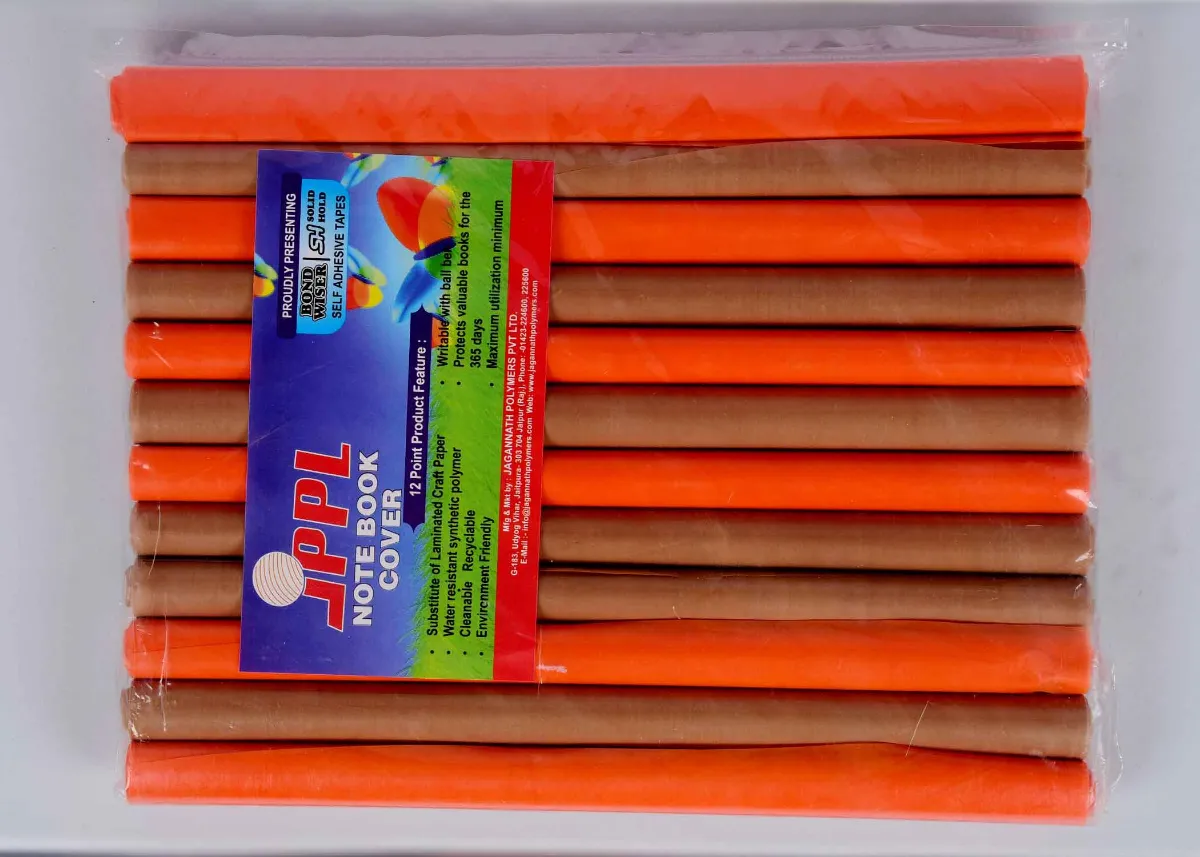
- Plain colours, for schools that want a uniform look. Brown and orange are the traditional ones. Our synthetic covers come in orange, pink, blue, brown, white and green as standard.
- Printed, for younger children. Cartoon prints on clear or coloured film.
- Fluorescent, for children who like bright colours. See our fluorescent covers.
The school lists in each retailer's area decide the mix. If the nearby schools ask for brown, brown needs depth in that shop. Our note on brown vs transparent covers explains what those lists usually mean.
The right widths
Most school notebooks need a 14 inch roll. Smaller books need 11 or 13 inch, which we make in the Standard series. Registers and long books need 16 or 19 inch, and we make those as wide covers. A retailer who keeps only 14 inch loses the register buyer.
It happens every time.
Which notebook covers sell fastest?
Across our whole range, we sell more Student JPPL, Unique, Floura and Clear than anything else. Student JPPL carries our name, and it is the cover we sell most.
I am proud of that one.
In your area, though, the school lists are the real guide. Ask your retailers what the lists asked for last season, note any changes as the new lists come in, and keep those designs in depth first.
How should your retailers display notebook covers?
A roll in a box tells the customer very little.
A covered book tells them everything.
These five things cost little, and you can help a shop set them up when you deliver its first stock of the season.
- Cover one regular notebook with each main design, and stand it beside the rolls. Parents choose faster when they can see the finished book.
- Stand boxed rolls upright on the counter or a stand. The printed box shows the design and the size.
- Keep one roll of each design open for touch, so customers can feel the thickness of a 70 micron cover against a 50 micron one.
- Put a small card with "covers about 18 notebooks" beside the 8 m rolls and "about 6" beside 3 m rolls. It saves the shopkeeper answering the same question again and again.
- Keep clear stationery tape next to the covers. A small roll of narrow tape fixes a lifting corner, and it is an easy add-on sale.
How do you and your retailers think about margin without guessing?
I will not quote prices or margins here, because they change and they differ by town. What I can share is the way to work out your own, and to help your retailers work out theirs.
Know the cost per roll
Standard rolls are bought by the kilo, in bags of 18 kg (11 and 13 inch) or 16 kg (14 and 16 inch). But a retailer sells them by the roll. So weigh one packet of ten rolls on a shop scale, divide by ten, and you know the weight of one roll. From the price per kilo you now know the cost per roll. Do this for every size, because a 2 m roll and a 4 m roll weigh very different amounts.
I think this one check, done with a simple scale, gives the most useful number in the whole category. Show your retailers how to do it once.
Know the cost per notebook covered
Boxed rolls and packs differ in length, so price per roll can mislead. Divide each roll's price by the number of notebooks it covers. On a 14 inch roll a regular notebook of about 24 x 18 cm uses about 43 cm, so 8 m covers about 18, 5 m about 11 and 3 m about 6. A retailer can use that number to set a price, and to answer a parent who asks why one roll costs more than another.
Thicker covers are easier to defend
A 70 micron cover feels different in the hand from a 50 micron one. When a customer can feel that, it is easier for the shopkeeper to explain the higher price.
We make every cover 50 micron or thicker, so even our low-price level is not flimsy film.
When should you stock, and how much?
Covers sell most from February to June. Most of our range is made to order, so your order needs to go in during December and January, and stock should reach your retailers by February. The full month-by-month plan is in when to stock notebook covers.
For quantity, start from last year's sales to your retailers. If this is your first season, count the books on a typical school list, multiply by the families the shops you supply serve, and convert to rolls using the coverage numbers above.
One honest limit
We pack Super Delux cartons in one colour each, except Combo, and each holds 180 or 200 rolls. That is a lot for one small shop that wants five colours. This is where a distributor earns its place. Buy full cartons from us, and split them into the smaller quantities each retailer needs.
If you are a distributor or wholesale dealer planning a season's range, send us your enquiry with the area you cover, the kind of shops you supply and the widths they sell. I am happy to suggest a mix.
Questions buyers ask
How can a notebook cover distributor help retailers sell more?
Give each retailer a range in three price levels, help them display a covered notebook beside each design, and get stock to them by February with the fast movers in depth. Then show them the cost per notebook covered, so they can price with confidence.
Should I supply small shops with boxed rolls or loose packs?
Supply what their customers ask for. Price buyers want packs and market rolls. Parents who want a full roll that looks good want boxed rolls. If you can, keep your best design in both. Our article on boxed vs packed covers goes through it.
Is it worth a retailer offering to cover books in the shop?
It can be, in the first weeks of the session when parents are short of time. It brings customers back to the counter and uses rolls the shop already stocks. Suggest they charge for the time, and keep it to the busy weeks so it does not tie up their staff all year.
Which covers sell fastest?
Across our range, Student JPPL, Unique, Floura and Clear sell the most. In your area the school lists decide it, so check which colours and designs the lists ask for before the season.