Why we do not make paper book covers
JPPL makes plastic book covers and no paper ones. Piyush gives his three reasons, short life, environment and cost, where paper wins, and what would change it.
We make plastic book covers and no paper ones. The simplest reason is something every stationery distributor and shop has seen: families who buy a brown paper cover usually put a transparent plastic cover on top of it, to make it last the year. If the book ends up wearing plastic anyway, we would rather make one good plastic cover than sell two layers. That is how our covers became synthetic.
Behind it are three reasons: a paper cover does not last long on a school book, on the ecological side we genuinely prefer plastic film, and over a year paper ends up costing families more.
I know the second reason will surprise some readers. Plastic is the villain in most conversations, and a packaging maker defending it sounds convenient. So let me explain each reason honestly, say where paper is genuinely better, and say what would make me change my mind.
Why did we make the cover synthetic in the first place?
Look at a school bag in July. Many books carry a brown paper cover with a clear plastic cover over it. Parents do this because they know the paper alone will not survive the year.
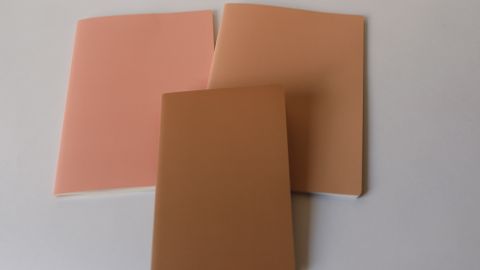
That double layer told us what families actually want: the look of a cover, and the life of plastic. A single synthetic cover does both jobs. It comes in plain colours, including brown and orange, so the book still looks covered in the familiar way, and it lasts without a second layer on top.
Does JPPL make paper covers at all?
No. Jagannath Polymers Pvt Ltd (JPPL) makes notebook covers in our own plant for stationery distributors and wholesale dealers, and all of them are plastic film: BOPP, PP and HM-HDPE. Every cover is 50 micron or thicker.
We are a film company. Our machines make film, and our people know film.
Yes, that gives us a business reason to prefer plastic. But our preference has an ecological side too, and I give those reasons below with sources, so you can judge them yourself.
Reason 1: why does a paper cover have a short life?
Think of where a school notebook spends its year. In a bag with a water bottle, under a lunch box, on a desk, in a child's hands at the bus stop in July.
A paper cover handles the first few weeks well. Then the corners soften, the spine rubs through, and one rainy day finishes it. The child comes home with a torn cover and the book needs covering again.
A plastic cover wears too, but more slowly. A spill wipes off. Damp does not soften it. A well-folded plastic cover is usually still on the book at the end of the session.
That is the whole first reason.
Short life is bad for the user, because a book with a torn cover is a book whose own cover gets damaged next.
Reason 2: why do we prefer plastic on the ecological side?
This is the reason I have to explain carefully, because it is easy to get wrong in both directions. But I will say it plainly: on the ecological side, we prefer plastic film for book covers, for reasons that go beyond our own business.
Paper is not as light on the earth as it looks. Making paper takes a great deal of water and energy, and so does recycling it. Water use in paper mills is a big enough issue that the Central Pollution Control Board runs a Charter for Water Recycling and Pollution Prevention in Pulp and Paper Industries for the sector. And a paper cover is hard to collect for recycling once it gets wet or dirty, which is exactly how most covers end the school year.
Then there is the count. What matters is not one cover, but how many covers a book uses in a year. If paper covers get replaced several times, all that paper, plus the tape used to fit it, adds up. A single plastic cover that stays on all year can do the same job with less material.
The UN Environment Programme makes a similar point about alternatives in general. In a story published on 23 November 2021, it says single-use products made of other materials "are not intrinsically better", and that a paper shopping bag may need to be used four to eight times to have a lower impact than one single-use plastic bag. That research was about shopping bags, not book covers, so I use it only for the principle: an item replaced often loses its advantage.
Now the other side, because it is real.
The same UNEP piece says plastics are the most persistent kind of marine litter. A paper cover thrown on the road will break down. A plastic cover will not. So my environmental argument only holds if two things happen: the plastic cover is used for the full year, and it ends up in dry waste, not on the ground or in a fire.
There is also a reason India sets a minimum thickness. When the Plastic Waste Management Rules, 2016 were notified, the Press Information Bureau release of 18 March 2016 said the 50 micron minimum for plastic sheets was meant "to facilitate collection and recycle of plastic waste". That is one more reason we never go below 50 micron.
I will not claim more than the evidence allows. On recycling, a 2022 review of plastic recycling in India (International Journal of Environmental Science and Technology) describes HDPE as widely regarded as recyclable. Our synthetic covers are HDPE. Our clear and printed covers are PP film, and clean PP film is widely recycled in India, in our experience as a film maker. It is other PP items that often go unrecycled. Recycling any of them still depends on someone collecting it.
Reason 3: why is paper the costlier choice?
Per sheet, the prices of paper and plastic covers vary from town to town, so I will not quote numbers. My point is about the year, not the sheet.
Every time a paper cover tears, a family buys another sheet, and someone spends another evening fitting it. Multiply that by a full bag of notebooks, and by every child in the house, and the cheap option stops being cheap. One plastic cover, fitted once, avoids that.
For a distributor, the logic is similar. A plastic roll does not go soft in a damp godown in the monsoon, so the stock we deliver in February is still saleable in June.
Where is paper genuinely better?
I said I would be fair, so here is the list.
- Paper comes from a renewable source.
- If it ends up as litter, it breaks down far faster than plastic.
- You can write the child's name and subject straight on it with any pen.
- Children can draw on it and decorate it.
- Many schools and families like the classic brown look, and some schools ask for it.
These are real points. If your school asks for paper, follow the school. If you love the brown look but want it to last, we make jute brown and orange brown Standard rolls in 11 and 13 inch, and brown in our plain synthetic covers.
What would change my mind?
Two things.
First, a paper cover that lasts a full school year in a real school bag, through the monsoon, at a cost families accept. If that product appears, my first and third reasons fall away.
Second, clear evidence that used plastic covers mostly end up burnt or thrown on the ground. If that were the normal fate of a cover, my second reason would weaken a lot. This is why I say disposal is part of the deal.
Until then, I will keep making plastic covers, at 50 micron and above, and keep saying where they belong at the end of the year: in dry waste. If you want to see both sides in one table, read paper cover vs plastic book cover.
If you are a distributor, your retailers will hear the paper question from parents every season. Feel free to share this page with them.
If you disagree with any of this, I would genuinely like to hear it. Write to us through the contact page.
Questions buyers ask
Is paper better for the environment than a plastic book cover?
Not automatically. Paper comes from a renewable source and breaks down faster if it is littered. But UNEP's review of life cycle studies found that alternatives to single-use plastic are not better by default and need to be used several times to come out ahead. A cover that lasts all year, then goes into dry waste, is a reasonable choice in either material.
Will JPPL ever make paper covers?
Not today. The reasons in this article would have to change first, mainly a paper cover that lasts a full school year in a school bag.
My child's school asks for brown paper covers. What should I do?
Follow the school. If you want the brown look with longer life, a jute brown or orange brown plastic cover is an option, but only if the school accepts it.